
Rock Salt vs White De-icing Salt: Which Winter Product?
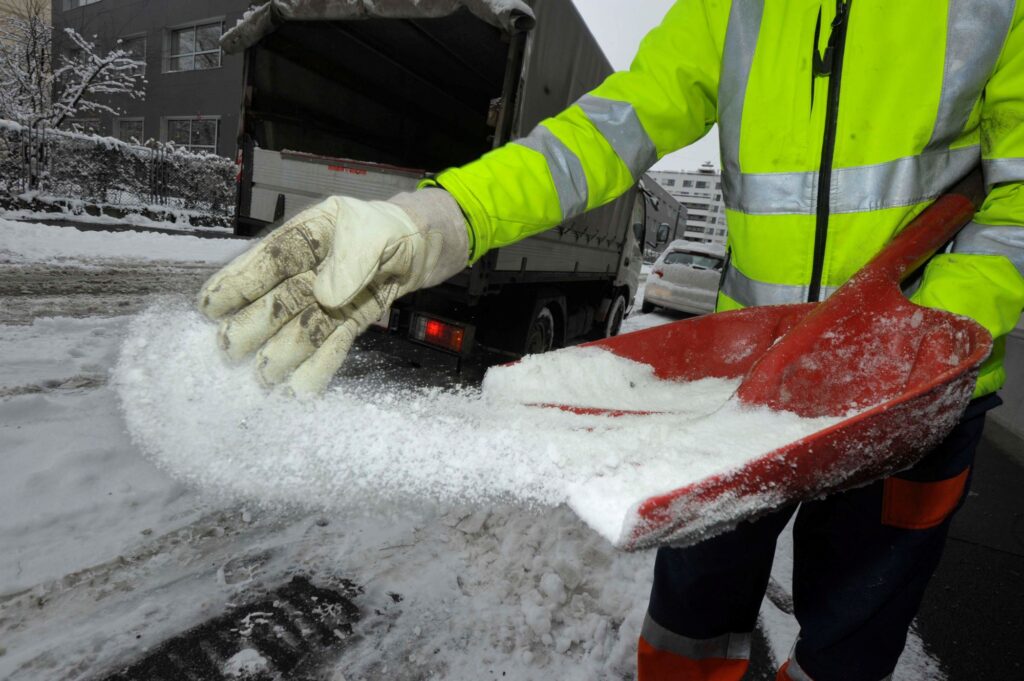
When comparing rock salt vs white de-icing salt, the key difference is purity: brown rock salt contains mineral impurities and leaves visible residue, making it ideal for large outdoor areas, while white de-icing salt is refined to minimize tracking and is preferred near building entrances and customer-facing areas.
Both are widely used across East Anglia by transport yards, facilities managers, food production sites and industrial estates. Choosing the right product depends on your site layout, surface type, budget and tolerance for residue tracking indoors.
Key Facts: Rock Salt vs White De-icing Salt
- Rock salt (brown): 6–10 mm grit, contains clay and mineral impurities, leaves visible brown residue, lower cost per tonne
- White de-icing salt: purer sodium chloride, minimal residue, less tracking, higher cost per tonne
- Performance: both work down to approximately -7°C; below that, calcium chloride or pre-wetted blends are needed
- Application rate: typically 10–40 g/m² depending on ice severity and forecast temperature
- Pack sizes: available in 25 kg bags, half-tonne bulk bags and loose bulk loads
What Is Rock Salt?
Rock salt is mined halite—natural sodium chloride extracted from underground deposits. It is crushed to 6–10 mm grit and sold with its naturally occurring impurities: clay, silt and trace minerals that give it the familiar brown or orange colour.
Those impurities do not reduce the melting performance, but they do leave a visible brown residue on hard standings, walkways and vehicle tyres. In wet weather or when tracked indoors, that residue turns into a gritty, muddy film that requires sweeping and mopping.
Rock salt is the most cost-effective option for large outdoor areas where appearance and tracking are secondary to performance: lorry parks, coach depots, recycling centres, farm access tracks and industrial yard perimeters.
What Is White De-icing Salt?
White de-icing salt is refined or washed sodium chloride with the clay and mineral content removed. It has the same ice-melting chemistry as rock salt but leaves far less visible residue.
Because it is cleaner, it is preferred for areas close to building entrances, retail forecourts, car showrooms, hospitality venues and any site where tracked salt would create a cleaning burden or visual issue. It costs more per tonne than rock salt, but that premium buys you reduced cleaning time and less indoor contamination.
White de-icing salt is not a different chemical—it is simply a purer form of the same sodium chloride. Both products work by lowering the freezing point of water, and both stop being effective at approximately -7°C.
Rock Salt vs White De-icing Salt: Performance and Temperature Limits
Both rock salt and white de-icing salt are based on sodium chloride and share the same effective temperature range: down to approximately -7°C. Below that, the brine they form begins to freeze, and melting action stalls.
If your site experiences prolonged sub-zero conditions or temperatures regularly drop below -7°C, neither product will perform reliably on its own. In those conditions, you need calcium chloride, magnesium chloride or a pre-wetted blend that can work at lower thresholds.
Application rate for both products is typically 10–40 grams per square metre, depending on ice thickness, ambient temperature and forecast conditions. Over-application wastes product and increases residue; under-application leaves patches of ice. Training your grounds or maintenance team in consistent spreading—ideally using a calibrated spreader—improves coverage and reduces waste.
Residue, Tracking and Site Cleanliness
This is the main operational difference. Rock salt leaves a brown, gritty residue that is highly visible on tarmac, concrete and block paving. In freeze-thaw cycles or rain, that residue turns into a slurry that clings to vehicle tyres, footwear and pallet truck wheels, then tracks into warehouses, workshops, offices and reception areas.
If your site has high footfall near entrances, or if you operate a customer-facing facility—garage forecourt, hotel car park, retail unit—then the cleaning cost and appearance impact of rock salt can outweigh its lower purchase price.
White de-icing salt still leaves some residue—it is still a mineral product—but the residue is far less visible and easier to sweep or wash away. It reduces the frequency and intensity of indoor cleaning, particularly in entrance lobbies, walkways and vehicle prep areas.
Cost per Tonne and Cost in Use
Rock salt is cheaper per tonne. White de-icing salt typically costs 20–40% more, depending on supplier and volume.
However, cost per tonne is not the same as cost in use. If rock salt tracking forces you to deploy additional cleaning resource—extra mop runs, entrance mat hire, pressure washing—then the true cost rises. Equally, if you over-apply either product because your team lacks calibrated equipment or training, you burn through stock faster and pay more per winter.
The most cost-effective approach is usually a zoned strategy: rock salt for perimeter roads, yard edges and low-visibility areas; white de-icing salt for pathways, car parks near entrances and anywhere that connects directly to occupied buildings. That splits the cost sensibly and keeps cleaning manageable.
Pack Sizes and Storage
Both rock salt and white de-icing salt are available in 25 kg bags, half-tonne bulk bags and loose bulk loads delivered by tipper. For most trade buyers, half-tonne bags offer the best balance of handling convenience, storage footprint and unit cost.
Store both products in a dry, covered area—ideally in a dedicated salt bin or under tarpaulin on a pallet. Sodium chloride is hygroscopic: it absorbs moisture from the air, which causes clumping and makes spreading harder. Wet salt also weighs more and performs less predictably.
Plan your winter stock based on your site area, typical winter severity in East Anglia and historical usage. Under-ordering risks running out mid-season when supply is tight; over-ordering ties up cash and storage space. We can supply both products on short lead times across Norfolk, Suffolk and Cambridgeshire, and samples are available for trial if you want to compare residue and handling before committing to bulk.
Which One Should You Choose?
If you manage a transport depot, industrial estate, farm or recycling centre where the priority is keeping roads and hard standings ice-free at the lowest cost, rock salt is the practical choice. Its residue is manageable outdoors, and the cost saving over a full winter is significant.
If you operate a garage forecourt, office park, hotel, car showroom or any site where appearance, customer perception or indoor cleanliness matters, white de-icing salt justifies the extra cost by reducing tracking and cleaning burden.
For many sites, the answer is both: rock salt for perimeter routes and yard areas, white de-icing salt for pathways, entrances and visitor parking. That zoned approach balances cost, performance and site presentation.
We supply both rock salt and white de-icing and water softener salt in 25 kg bags, bulk bags and loose loads across East Anglia. Delivery is free on orders over £50, and we aim to despatch within two working days. If you are unsure which product suits your site, request samples so your team can trial both and compare residue, spreadability and tracking before the season starts.
Frequently Asked Questions
Can I mix rock salt and white de-icing salt?
Yes, you can blend them if you want to balance cost and residue. Some buyers do this in a dedicated spreader hopper. Be aware that the brown particles will still track, so mixing only partly reduces the cleanliness issue.
How much salt do I need per square metre?
Application rates typically range from 10 to 40 grams per square metre, depending on ice thickness and temperature. A calibrated spreader and site-specific gritting plan improve accuracy and reduce waste. We provide guidance on application rates and can help you calculate stock requirements for your site.
Does white de-icing salt work faster than rock salt?
No. Both are sodium chloride and work at the same rate, provided particle size and application rate are comparable. The difference is cosmetic and operational—residue and tracking—not chemical performance.
What temperature is too cold for salt to work?
Sodium chloride-based de-icing salts, whether rock or white, stop working effectively below approximately -7°C. If your site regularly experiences colder conditions, you need a calcium chloride or magnesium chloride product, or a pre-wetted blend designed for lower thresholds.
Get a Quote for Rock Salt or White De-icing Salt
We supply both rock salt and white de-icing salt in bags, bulk bags and loose bulk across Norfolk, Suffolk and Cambridgeshire. Delivery is free on orders over £50, and samples are available for trial. Call us on 01953 607093 option 2 or request a quote through the website, and we will confirm stock, pack sizes and lead time for your winter de-icing requirements.
Cleaning and hygiene guides
- Concentrated Chemicals Cost Per Use: True Value Guide
- General Maintenance Norwich
- Hand Dryers vs Paper Towels: Which Is Right for You?
- TFR Traffic Film Remover Guide for Fleet Operators
- Washroom and Kitchen Supplies: A Complete Guide
- Rock Salt vs White De-icing Salt: Which Winter Product?
- How to Choose General Maintenance Products
- Cleaning and Sanitising Products: Complete Guide
- Paper Products Guide: Choosing for Your Business