
Can You Use Rock Salt as Salt for Water Softener? A Guide
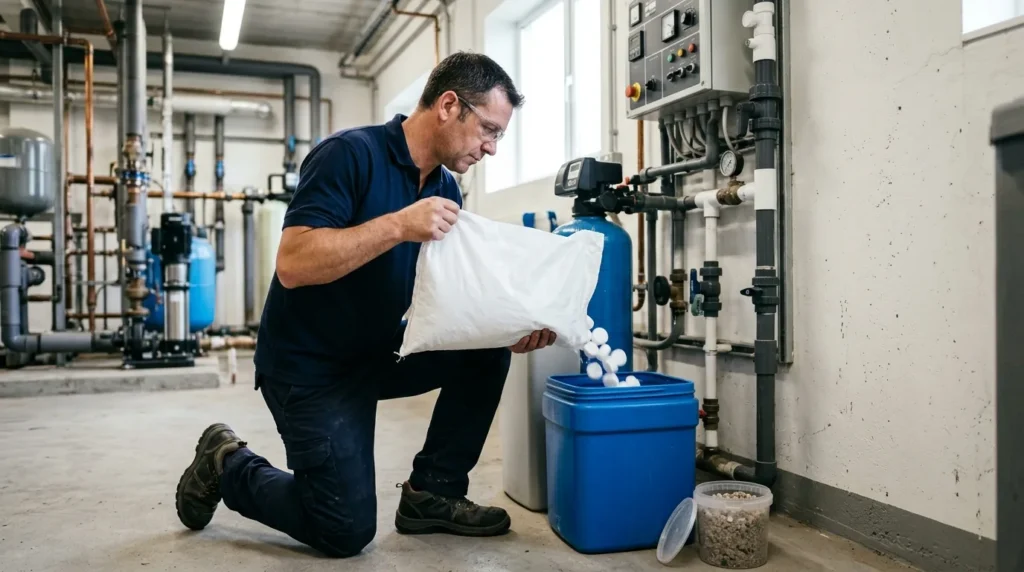
The answer to ‘can you use rock salt as salt for water softener units’ is no: rock salt is a de-icing product, and its insoluble content can settle in the brine tank and foul the softener’s valves and injector. Use the purified salt your softener’s manufacturer specifies, usually tablet, granular or block salt, and check the unit’s manual before you change products.
We get this question regularly from facilities and site managers across Norfolk and East Anglia, often after someone has spotted a pallet of gritting salt in the yard and wondered whether it would do. This guide explains why it won’t, and how to choose the right salt for the softener you actually have.
Key facts
- Rock salt is made for de-icing roads and yards. It is not made for regenerating water softeners.
- Rock salt contains insoluble material that does not dissolve in the brine tank and can cause blockages.
- Water softeners regenerate their resin with a brine made from purified salt, sold as tablets, granules or blocks.
- The softener manufacturer’s manual is the authority on which form of salt your unit takes.
- Ask your supplier for the product data sheet and safety data sheet before you switch salt types.
Can you use rock salt as salt for water softener systems?
A water softener works by passing hard water through a bed of ion-exchange resin. Over time the resin becomes loaded with the hardness minerals it has removed, so the unit periodically regenerates it by drawing brine from the salt tank and flushing it through. That brine needs to be clean.
Rock salt is mined and used largely as it comes out of the ground. That is exactly what you want on a frozen car park, because the grit adds traction. In a brine tank, though, the insoluble part has nowhere to go. It settles as a sludge at the bottom of the tank and can be drawn towards the brine pick-up, injector and valves. The usual results are:
- poor or failed regenerations, so hard water gets through to the site
- blocked injectors or brine lines that need an engineer to clear
- more frequent tank cleaning
- scale building up on the equipment the softener is there to protect, such as boilers, calorifiers, dishwashers and process equipment
For a trade site, the cost is not the bag of salt. It is the service call-out and the scale damage that follows if a softener quietly stops working. Saving on salt is a false economy.
If your query is really about de-icing, our guide to white de-icing salt versus rock salt covers that side.
Which salt does your softener need?
Water softener salt is a purified salt made specifically for regenerating resin. It comes in three main forms, and they are not always interchangeable.
Tablet salt
Compressed tablets are the most common form for commercial and light-industrial softeners with an open brine tank. They dissolve steadily, and the gaps between the tablets let water circulate, so they are less prone to clumping than finer salt. If you are not sure what your unit takes and the manual says tablets, buy tablets.
Granular salt
Some softeners, often older units or those with particular brine tank designs, are built for granular salt. In a tank designed for tablets, granular salt can pack down, form a hard crust or ‘bridge’ across the tank, or turn to mush. All of these stop brine forming properly.
Block salt
Certain softener models are designed to take moulded salt blocks only. They usually have no conventional open brine tank, and loose salt will not work in them. If your unit takes blocks, use blocks made for that model.
How to check before you buy
Before you place a repeat order or change supplier, take a few minutes to confirm what the site really needs:
- Find the softener’s make and model on the unit’s data plate.
- Check the manufacturer’s manual, or the service contractor’s notes, for the salt type specified.
- Ask your supplier for the product data sheet and confirm the salt is made for ion-exchange regeneration. The relevant European standard for this use is BS EN 973. Ask whether the product you are offered conforms to it.
- Get the safety data sheet. Even low-hazard products should have their handling and storage covered in your site records under the COSHH Regulations 2002 (HSE guidance).
- Agree a storage spot that is dry and off the floor, so the bags don’t absorb moisture and cake before they are used.
If you are moving between forms, for example from granular to tablet, check with the softener’s manufacturer or service engineer first. The tank may need emptying and cleaning before you switch.
Signs your softener is struggling with the wrong salt
- Salt level in the tank barely drops between top-ups. This is a sign of bridging.
- Standing water above a solid salt layer, or a sludgy layer at the bottom of the tank.
- Scale reappearing on taps, glass washers, kettles or heat exchangers.
- Regeneration cycles running, but hardness tests showing hard water downstream.
If you see any of these, have the unit checked by whoever services it. Do not simply add more salt.
Buying for multiple sites
Estates, schools, food production units and multi-site operators often run softeners from different manufacturers that need different salt forms. It pays to keep a simple register of each unit, the salt it takes and how quickly it uses it, so reorders go to the right site in the right form. We can help you set this up alongside the rest of your consumables, including salt for water softener units and de-icing salt for the winter, with a single point of contact for your chemical supplies.
Frequently asked questions
Can I mix tablet and granular salt in the same tank?
It is best not to. Different forms dissolve and settle differently, and mixing them can encourage bridging. Stick to the one form your softener’s manufacturer specifies.
Is dishwasher salt the same as water softener salt?
Both are purified salts used to regenerate softening resin, but they are sold in different forms and pack sizes for different equipment. For a standalone softener, use the product made for it and follow the manual.
Can I use de-icing salt in an emergency if we run out?
We would advise against it. One bag of rock salt can leave insoluble residue in the tank that has to be cleaned out afterwards. It is better to let the tank run low briefly while you get the correct salt delivered.
Do you provide COSHH information for salt products?
Yes. We supply safety data sheets with our products and offer free COSHH assessments for many of the products we sell, so your records are straightforward to keep up to date.
Getting the right salt delivered
Milne Chemicals is part of the Milne Safety group, which has been supplying chemicals to businesses since 1978. We deliver across East Anglia, including Wymondham, Norwich, Attleborough, Dereham and Thetford, with free delivery on qualifying orders. We aim to despatch within 2 days, with up to two pallets per delivery. Samples are available on request, and we can source products to order if your equipment needs something specific.
Call us on 01953 607093 (option 2) or contact us for a quote. Tell us your softener’s make and model and we will help you match the right salt to it.