
Brown Salt vs White Salt: Which Is Better for De-Icing?
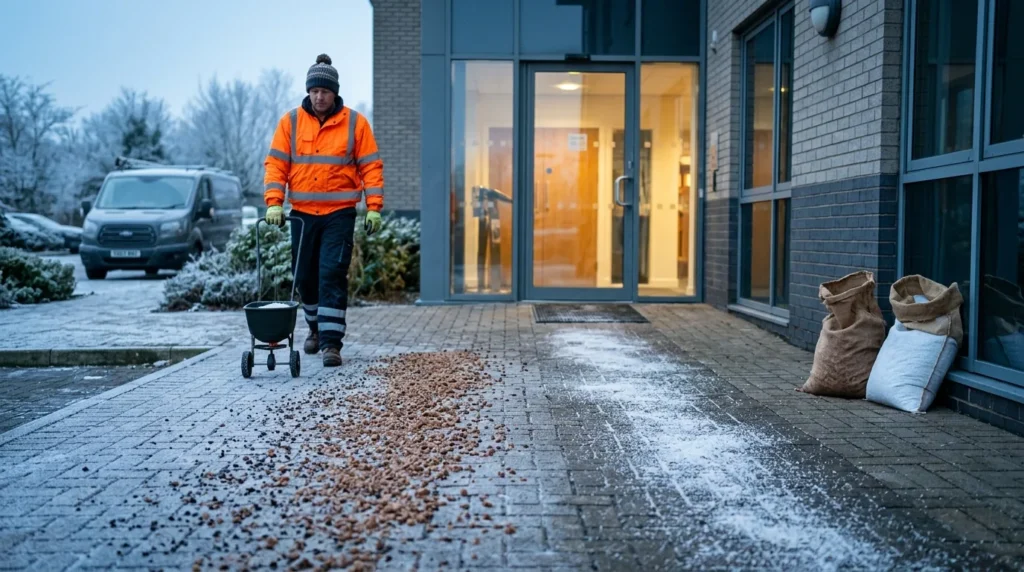
In brown salt vs white salt comparisons, brown rock salt is usually the better choice for open car parks, service yards and long pavement runs where cost per area matters most, because its grit adds grip and it is generally the cheaper option. For busy entrances, retail frontages and anywhere salt gets walked indoors, white de-icing salt usually works out better value overall, because it dissolves cleanly and leaves far less residue to clean off floors and mats.
Many sites use both: brown salt on the open areas and white salt within a few metres of the doors. Below, we set out how each one performs so you can decide where each belongs on your site.
Key facts
- Brown and white de-icing salt are both sodium chloride. They melt ice in the same way.
- Brown rock salt contains natural grit and insoluble material. This gives extra traction but leaves a gritty, muddy residue once the ice has gone.
- White salt is a purer, more refined product. It dissolves cleanly and leaves far less residue.
- Rock salt is effective down to around -7C. Do not rely on salt alone in colder conditions without checking the product data sheet.
- Brown salt is generally cheaper per bag. White salt generally costs less in cleanup at entrances.
- We supply both from Wymondham, with delivery across East Anglia.
Brown salt vs white salt: how they differ
Brown rock salt is mined and sold with much of its natural mineral content left in. The brown colour comes from insoluble grit and clay. When the salt dissolves, that grit stays on the surface. On an icy car park this helps, because pedestrians and vehicles get some grip while the salt is working.
White de-icing salt has been refined or purified to a higher sodium chloride content, with little or no insoluble matter. It goes into solution cleanly. Once the ice has melted, the surface is left wet rather than gritty, and there is far less material to sweep up or track indoors.
The melting action itself is the same for both products, because both rely on sodium chloride lowering the freezing point of water. The real differences are what is left behind and what each costs to buy and to clean up after.
Cost: purchase price versus total cost
Brown rock salt is generally the cheaper product to buy, which is why councils and large estates use it on roads and open ground. If you are treating a large car park, haulage yard or farm access road where nobody walks the residue indoors, brown salt is hard to beat on value.
At a busy entrance, the purchase price is only part of the cost. Brown salt residue tracked through the doors means:
- extra mopping and machine scrubbing time for cleaning staff or contractors
- dirtier, faster-wearing entrance matting
- gritty dust working into carpets, floor finishes and lift thresholds
- a poorer first impression for customers at retail and office sites
When you add that labour and wear into the calculation, white salt often works out cheaper overall at high-traffic doorways, even though it costs more per bag.
Cleanup and floor care
This is where white salt clearly wins. It leaves little visible residue, so entrance floors stay cleaner. However, any salt dissolved in meltwater can still dry to a white bloom on hard floors, so a regular entrance cleaning routine is still needed.
If you want help building that routine, our floor cleaning chemicals range covers the cleaning products. We can also put together bespoke on-site cleaning procedures for your staff or contractors, alongside free COSHH assessments for many of the products we supply.
Grip and safety on walkways
Slips on ice are a foreseeable risk for most trade sites. For the wider picture, see the HSE guidance on slips and trips. Both salts treat ice, but they behave differently:
- Brown salt gives some immediate grip from its grit, which helps on slopes, ramps and open walkways.
- White salt gives no grit benefit. It relies entirely on melting, so treat surfaces before ice forms where you can.
- Neither product works instantly on thick ice or compacted snow. Clear what you can first.
- Before treating new concrete, natural stone, block paving or areas near planting, check the manufacturer’s guidance.
Which should you choose?
A simple rule works for most sites:
- Choose brown rock salt for car parks, service yards, haul roads, farm tracks and long perimeter paths.
- Choose white salt for shop and office entrances, reception approaches, hospital and care-home doorways, and anywhere foot traffic comes straight indoors.
- Use both on mixed sites. Put brown salt on the open ground and switch to white within a short distance of each entrance.
For a closer look at how the two products compare, see our rock salt vs white de-icing salt comparison. You can also browse our full de-icing and water softener salt range.
Frequently asked questions
Is white de-icing salt more effective than brown rock salt?
Not at melting ice: both are sodium chloride, so the melting chemistry is the same. White salt’s advantage is that it is cleaner, not that it melts more ice, while brown salt’s advantage is the added grip from its grit.
How cold does it have to be before salt stops working?
Rock salt is effective down to around -7C. For the working range of a specific product, check the manufacturer’s data sheet, which we can supply. If your site regularly sees colder conditions, talk to us about the options.
Which salt is better for a retail car park?
We usually recommend brown rock salt on the parking area itself, because it is lower cost and gives grip, and white salt on the walkways and entrance approach to keep the shop floor clean.
Can we try a product before ordering in bulk?
Yes. Samples are available for trial on request. We can also source specific products to order if you need something we do not stock as standard.
Get your winter salt sorted
Milne Chemicals is part of the Milne Safety group, which has supplied chemicals since 1978. We supply brown rock salt and white de-icing salt to businesses across Wymondham, Norwich, Attleborough, Dereham, Thetford and the wider region, with delivery across East Anglia and despatch aimed at within 2 days. Call us on 01953 607093 option 2 or request a quote, and ask about samples for trial.